

Amul’s brand strategy story begins not in a boardroom, but in the rural villages of Gujarat, where millions of small dairy farmers came together to challenge exploitation and middlemen. The foundation of Amul’s brand deck is this cooperative spirit. Owned by farmers and managed collectively through the Gujarat Cooperative Milk Marketing Federation (GCMMF), Amul positions itself not just as a dairy company, but as a people’s movement. This origin story becomes the emotional anchor of the brand strategy—every glass of milk, every pack of butter represents empowerment, fairness, and trust. The brand deck highlights how this unique ownership model transforms farmers into stakeholders, ensuring consistent quality, steady supply, and deep-rooted authenticity that no private competitor can easily replicate.
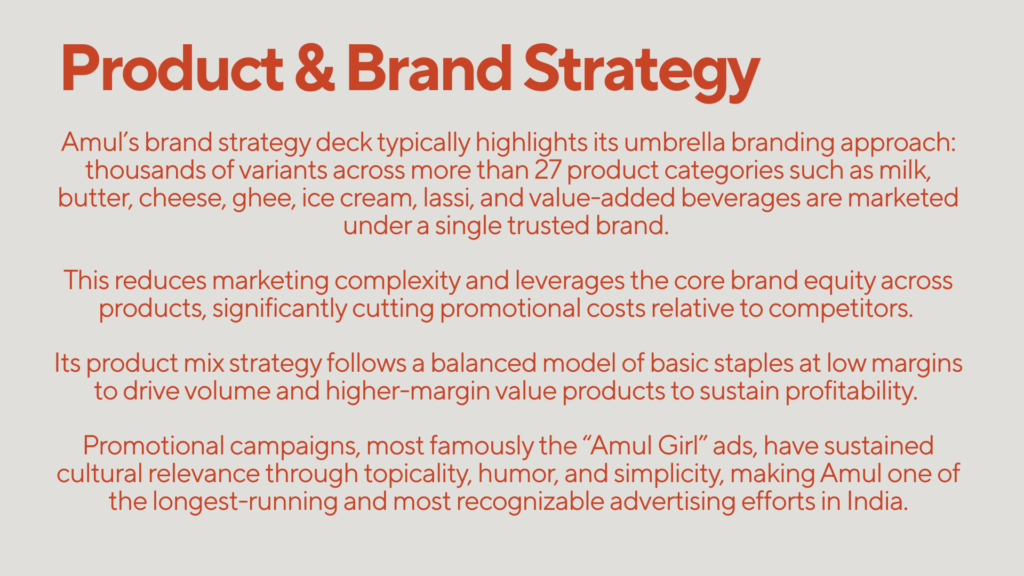
As the story unfolds, Amul’s strategy deck shifts focus to how a single brand became the “Taste of India.” Instead of creating multiple sub-brands, Amul adopted a strong umbrella branding strategy. Milk, butter, cheese, ice cream, curd, ghee, and beverages all carry the same red-and-white logo. This decision simplified consumer choice and built instant recognition across generations. The deck emphasizes how this consistency reduced marketing costs while amplifying brand recall. Iconic campaigns like the Amul Girl advertisements appear as cultural milestones in the story, showing how topical humor and simplicity allowed the brand to stay relevant for over five decades without losing its core identity.
The next chapter of the brand strategy focuses on scale and accessibility. Amul’s deck tells a story of reach—how the brand travels from village collection centers to nearly one million retail outlets across India. With over 10,000 distributors and a vast cold-chain infrastructure, Amul ensures that freshness and availability are never compromised. The strategy positions distribution not as a backend operation but as a competitive advantage. Affordable pricing is woven into this narrative, reinforcing Amul’s promise of value-for-money while still paying farmers fairly. This balance between affordability and sustainability is a central tension the brand has mastered over time.
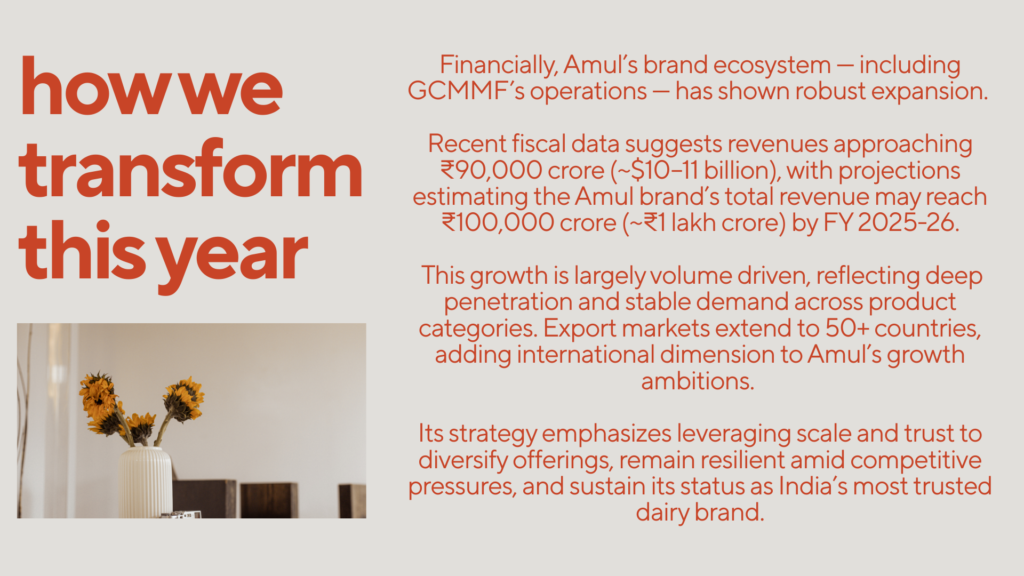
From a data perspective, the brand deck highlights Amul’s dominance in the Indian dairy market. Amul commands a leading share in key categories such as butter, cheese, and packaged milk, and serves consumers across urban and rural segments. The brand is valued at over USD 4 billion and consistently ranks as India’s strongest food brand. Financially, Amul’s revenues are nearing ₹90,000 crore, with projections crossing ₹1 lakh crore in the near future. These numbers are not just metrics in the deck—they are positioned as proof that a cooperative model can outperform traditional corporate giants.
The story concludes with Amul looking toward the future while staying grounded in its roots. The brand strategy deck frames innovation—new products, digital distribution, exports to over 50 countries—as a natural extension of trust built over decades. Amul’s narrative is not about chasing trends, but about evolving responsibly. In the end, the deck doesn’t sell a product; it tells a story of collective growth, resilience, and a brand that belongs to the nation as much as it belongs to its farmers.


Leave a Comment